
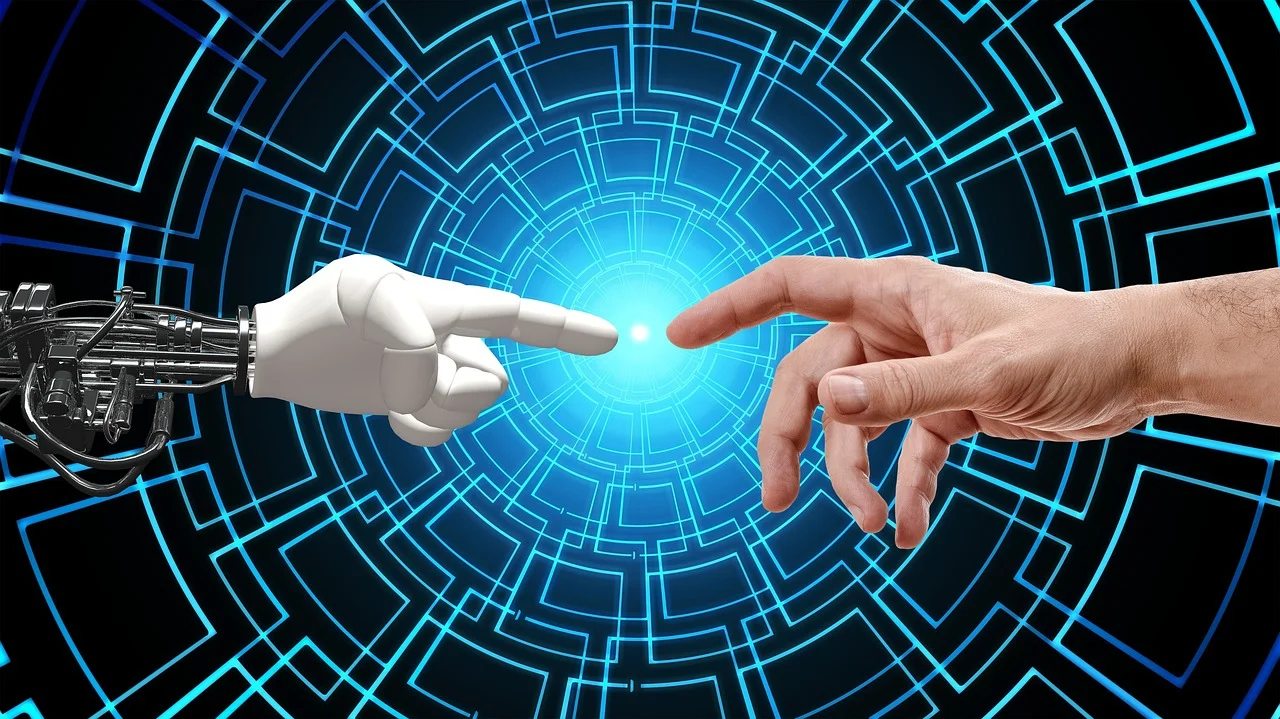
Asking Chat GPT or creating an illustration with DALL.E have become everyday tasks in our time, without realizing it we have seen how Artificial Intelligence (AI) has gone from being a futuristic technology to being a tool that we use every day. a day. Creative AIs are one of the branches of this technology that is experiencing the greatest growth and development to the point that it is dizzying to see what they are capable of doing and the impact that artificial intelligence is currently having on music is already a reality.
In 2018, a painting created by a creative AI was sold at auction for almost half a million dollars, recently we have seen how David Guetta used a simulation of Eminem’s voice created by AI during one of his sessions or an unexpected featuring between The Weeknd and Drake , these examples are just a few that show the impact that AI is having on the creative industries and the music industry.
Although AI is increasingly used in music, we still do not have legal frameworks that regulate this technology, which has constantly given rise to legal conflicts and debates. At Sympathy for the Lawyer we try to shed light on this topic to understand what the current context is and where we are heading in this guide on the legal implications of artificial intelligence in the music industry.
Are works created by artificial intelligence protected by copyright?
The first question that arises is whether a work created by AI is protected by copyright. The Intellectual Property Law establishes that, for a work to be protectable, it must be original and created by a natural person . This leads us to ask ourselves two questions when analyzing whether a work is protected by copyright: is it the original work? And has it been created by a natural person? Let’s analyze them.
Is a song created by AI an original work?
Originality is a legal concept that is not defined in the law, so it has been the courts and doctrine that have been configuring this term, having defined two aspects of this concept .
The subjective conception of originality understands that a work is original if it is a reflection of the personality of its author , this being sufficient for the work to be protected. This conception arises from the doctrine of the Court of Justice of the European Union and our Supreme Court, which in repeated rulings have established originality as the fruit of the author’s own intellectual creation.
The objective conception of originality has been gaining strength in recent years, both in scientific and legal doctrine, and it is precisely this conception that could open a door for works generated by AI to be protected by Intellectual Property. In this sense, originality is understood as novelty, as the creation of something that did not previously exist , which allows the work to be recognized and differentiated, a requirement that many of these works would meet.
Currently, the subjective aspect is predominant in most countries in the world, especially in countries with a continental legal tradition such as Spain and our neighbors in the EU, which represents an obstacle to the protection of works created by AI. However, companies that develop creative AI usually include in their conditions of use and legal terms that the rights to the works created by their AI belong to them, so prevention is better than cure.
Who owns an AI-generated song?
In this case, the Law is clear, the author is a natural person, and this is the case in all legislation in the world, which is why it is impossible today for a work created by an AI to be protected, since there is no author . behind that work . Therefore, although the objective aspect that we talked about in the previous section will end up being imposed, we would continue to encounter legal obstacles to the protection of AI works.
That said, in law we find legal fictions that have been created for their convenience for society. At the time, companies were given legal personality because it was favorable for commerce. In the Intellectual Property Law itself we also find these legal fictions, such as that the ownership of the rights to software belongs to the company that has organized and provided the means for its creation and not to its programmers. These are just some examples that make us ask ourselves the following question: Could AIs be recognized with personality if this were useful for society? Well, precisely this debate has already reached the Institutions, as we tell you below.
The e-personality or electronic personality of artificial intelligence
Within the European Union, specifically in Parliament, the issue of creating a legal personality for autonomous AI systems began to be discussed a few years ago. This was reflected in the European Parliament Resolution of February 16, 2017, with recommendations to the Commission on civil law rules on robotics, where in its Recommendation 59.f) the Parliament asks the Commission to create a personality specific legal for robots ( e-personality ) in the long term. In the United States Congress This possibility was also addressed, and in the discussion, many AI technology experts and legal professionals discussed the need to create a specific personality for robots.
The reason why many countries are considering creating this e-personality is due to growing concerns about who is responsible for the damage caused by these autonomous AI systems. The paradigmatic case is that of Tesla’s autonomous cars, which have already caused multiple accidents with injuries and even deaths, but there are many other cases in which determining who is responsible when an AI system is involved is not a simple task, as we will see more. forward.
The creation of an electronic personality for AIs is no utopia (or rather dystopia). As we have seen, it has already been raised in institutions such as the European Parliament and the US Congress, and the development of these technologies grows exponentially year after year, so we must prepare for a future in which AIs have a sort of legal personality.
Everything indicates that, in the first instance, this electronic personality would only have obligatory content , in particular, the responsibility to compensate for damages caused to third parties. But it would probably end up also being provided with rights, especially property rights that allow AIs to have an “asset” with which to face this liability for damages. This could open the door to introducing legislative reforms that would allow AIs to be copyright holders, especially in their patrimonial aspect.
The United Kingdom and China recognize protection for works created by artificial intelligence
Although it still seems impossible for AIs to be recognized as authors or to hold copyright, we have two paradigmatic cases in which copyright protection has been recognized for these works , granting their ownership to natural or legal persons who can hold this type of rights. Perhaps these cases that we are going to see are indicative of where we are going.
The countries of the Common Law legal tradition, these are the United Kingdom and its former colonies, have in their copyright regulations a figure called Computer Generated Works (CGW). This legal figure establishes that the rights to a work created by computer belong to the person who has made the necessary arrangements for its creation . As we can see, the rule is somewhat vague, but at least it serves as a starting point to determine who is the owner of a work created by a computer or currently an AI.
It is precisely this figure that has allowed countries such as the United Kingdom and China to already have rulings in which copyright protection of works created by computer and even AI software has been recognized.
In the UK we have the case Nova Productions Ltd v Mazooma Games Ltd. in which Nova sued Mazooma for copyright infringement. The lawsuit arose because Mazooma had used images for one of its video games that were a copy of other images that appeared in a Nova video game. The curious thing about the case is that these images were created by software integrated into the video game itself, there was no human intervention. The Supreme Court of the United Kingdom concluded that the person who had made the necessary arrangements for the creation of the work was the programmer of the software and that therefore the rights to those images belonged to him.
Relying on the same CGW doctrine, the Shenzhen Nanshan District People’s Court also resolved a plagiarism case between Tencent Computer and Shanghai Yingxun . The lawsuit came because Shanghai Yingxun had been copying and publishing financial news first published by Tencent on its website. Again, the interesting thing about the case is that the financial news was written by AI Dreamwrite , an AI system owned by Tencent, which is capable of analyzing the stock market and writing relevant news for investors autonomously. The Chinese Court ruled that the literary work created by IA Dreamwrite was protected under Chinese law and that the owner of its rights was Tencent, forcing Shanghai to compensate for plagiarism.
And what happens if an AI plagiarizes an artist? Who is responsible?
Another hot point is the liability for damages caused by AI. Who is responsible for the damages caused by an AI? Even more so when there are already systems that are autonomous. This, in the field of the music industry, has a double aspect:
On the one hand, we have the possibility that a song created by AI turns out to be plagiarized from another song . In this case, and if it were proven that such plagiarism actually exists, it is evident that someone would have to be responsible for paying compensation to the injured author, but in the case of a work that no one has created, but rather an AI, to whom is responsibility requested?
At first, the most logical thing would be to sue the person who used AI and published the song, but we could also understand that the company that developed the AI system, the programmers or the licensees of that software are responsible. They market it to users. Even digital platforms could be considered responsible for serving as databases for these AI systems. In this sense, it is important to bring up the open letter that Universal addressed to Spotify and Apple Music a few days ago, asking them to restrict access to their repertoire. to AI development companies that are using it to train their AIs, even threatening legal action.
On the other hand, we have the almost perfect emulations of the voice of famous artists . This is giving rise to some people using this technology to make songs in which it seems that it is the artist himself who is performing them. The cases of The Weeknd and Drake, the ‘new album’ by Oasis or David Guetta with Eminem are some examples of a trend that seems unstoppable. In these cases, although we would not be talking about a violation of intellectual property rights, there would be a violation of image rights, since the voice, and even more so if it is as recognizable as that of a famous artist, is protected within the right of image. Once again we would have the same problem as before to determine who or who are responsible for such a violation.
Conclusions and opinion of the author
Reality is overtaking legislation at a rapid pace, while AI is present everywhere, including the music industry, legislators seem afraid to address the issue and begin legislating on it.
In the music industry, and in general in all creative industries, this lack of legislation is causing uncertainty and legal insecurity for all market operators. Massive rights violations and job losses are some of the fears that hover around the emergence of AI in music. But not everything is so terrible, there are also people who are embracing this technology and who see its potential as an instrument that can bring great benefits to the sector.
Luckily, AI does not yet have the will, so it is our mission to urge legislators to regulate in a way that protects the interests of the people and companies in our industry , while at the same time we can coexist with this new technology and take advantage of it. of its advantages.
“Just as a musical instrument is an extension of human ability, artificial intelligence has become an extension of the creative potential of music” (ChatGPT)